
Concrete Testing
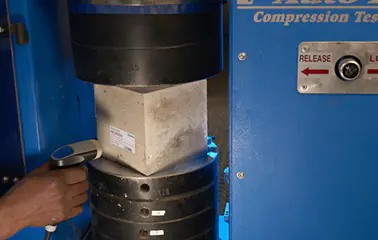
Civil Engineering Concrete Testing Services
When using fresh concrete, understanding the mechanical and physical properties helps to determine its workability, stability, and hardened state strength, along with testing for durability and long-term properties.
Alongside concrete testing. Civilab also carry out testing for suitability of aggregates to be used for concrete. Understanding the components and the quality of concrete delivered to a site, and through structural engineering, ensures concrete that is often used to support heavy loads is tested to make sure its strength and durability are sufficient.
Concrete Testing Services
Evaluates the ability of concrete to withstand axial loads, a fundamental property for structural integrity.
one of the key aspects of the infrastructure longevity is the concrete durability.
Assesses the workability and consistency of fresh concrete before placement.
Civilab can assist you with regular sampling and collection of samples from your projects.
we conduct the Schmidt hammer test and Ultrasonic Pulse Test, a non-destructive method that assesses the quality and homogeneity of concrete by measuring the speed of an ultrasonic pulse passing through the material.
to assist engineers and contractors in determining the optimum design of the concrete and measuring performance for specific projects.
Other Concrete Testing Services
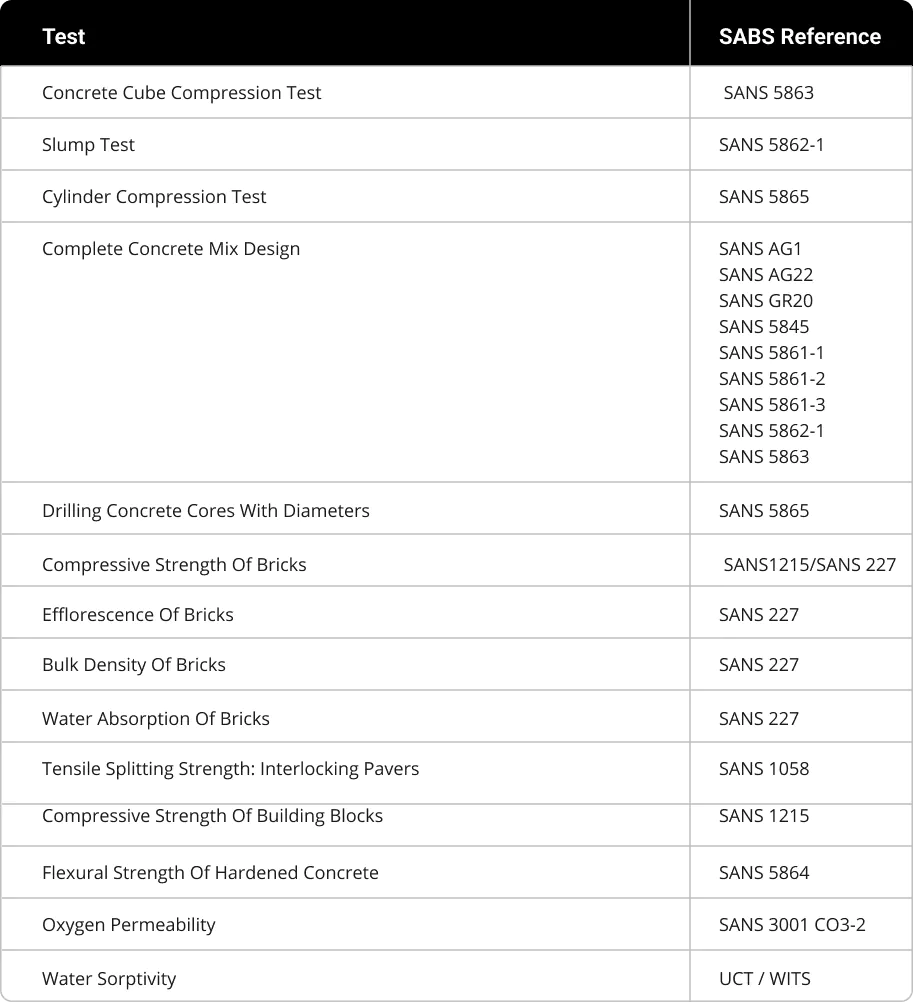
Concrete Durability
Concrete durability tests assess the long-term performance of concrete under various environmental conditions. These tests are crucial for ensuring that the concrete will withstand its stresses over its lifespan and protect the steel within from exposure to oxygen and moisture.
Durability tests include evaluating resistance to chloride ion penetration, which is critical for structures exposed to de-icing salts or marine environments. Chloride ions can cause corrosion of steel reinforcement, leading to structural deterioration. Chloride conductivity, oxygen permeability, and water sorptivity help ensure durability specifications are attained. Carbonation testing on older structures assesses the depth of carbonation in concrete, which can lead to the corrosion of reinforcement if not adequately protected by sufficient cover to reinforcement elements.
Ensuring concrete durability involves selecting appropriate aggregates, mix designs, and construction practices. Regular testing and monitoring throughout the structure’s life help maintain its integrity and prolong its service life.
Frequently Asked Questions
- What is a Concrete Cube Test?
A concrete cube test is where a hardened concrete cube sample, generally 150mm square, is crushed in a hydraulic machine. An increasing load is applied at a uniform rate to the cube until failure, providing a compressive strength value reported in MPa.
- Why are concrete cube tests important?
Concrete cube tests are essential as they verify the strength of the freshly mixed concrete.
- What is a concrete slump test in concrete?
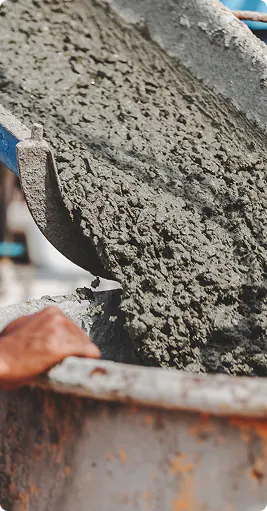
The concrete slump test is a common concrete testing method used to measure the consistency of fresh concrete before it sets. This is crucial for evaluating how much water has been used in the concrete mix, its ability to flow, and if it is suitable for its intended use.
- How do you test a concrete core?
A concrete core is prepared in a laboratory by preparing each end of the core, the ends are flat and perpendicular to the longitudinal axis of the core. The core is then placed in a hydraulic crushing machine and crushed at a steady rate until ultimate compressive strength is reached.
Why Choose Civilab for Concrete Testing?