
Ultrasonic Pulse Velocity (UPV) Testing
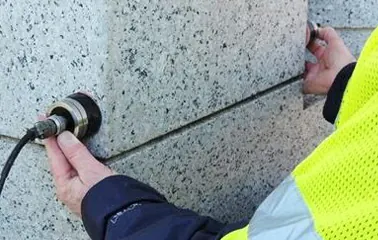
Non-Destructive Evaluation for Concrete Integrity
Ultrasonic Pulse Velocity (UPV) testing is a non-destructive technique used to assess the quality and uniformity of concrete. By measuring the velocity of ultrasonic pulses through concrete, engineers can detect internal flaws, estimate material properties, and ensure structural integrity.
Principle
The UPV test involves transmitting ultrasonic pulses through concrete using a pair of transducers—a transmitter and a receiver. The time taken for the pulse to travel between the transducers is measured, and the pulse velocity (V) is calculated using the formula:
V = L / T
Where:
• V = Pulse velocity (m/s)
• L = Path length between transducers (m)
• T = Travel time of the pulse
Higher pulse velocities generally indicate better quality concrete, while lower velocities may suggest the presence of voids, cracks, or other defects.
Applications
- Assessing concrete uniformity and quality
- Detecting internal flaws such as voids and cracks
- Estimating concrete strength and modulus of elasticity
- Monitoring strength development over time
- Evaluating the effectiveness of repair work
- Determining the depth of surface cracks
Advantages
- Non-destructive and does not damage the structure
- Provides immediate results on-site
- Portable equipment allows for testing in various locations
- Applicable to both new and existing structures
- Complies with international standards such as ASTM C597 and IS 516 Part 5 Section 1
Limitations
- Requires access to both sides of the concrete element for direct transmission
- Surface conditions and moisture content can affect results
- Interpretation of results requires experienced personnel
Conclusion
UPV testing is an essential tool for evaluating concrete structures without causing damage. It provides valuable information on the internal condition of concrete, aiding in quality control, maintenance, and safety assessments.