
Sample & Field Testing
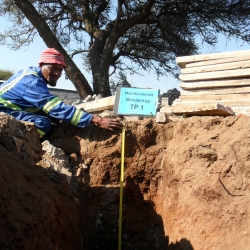
Field Testing
Civilab offers a variety of field-testing services to suit the project’s needs.
We offer comprehensive field-testing services through dedicated teams equipped to perform on-site assessments and sampling. Our capabilities encompass a range of tests, including but not limited to:
• Field Density Testing: Utilising methods such as sand replacement and nuclear gauge (Troxler) to determine soil compaction levels.
• Dynamic Cone Penetrometer (DCP) Testing: This is essential for evaluating subgrade conditions, as it assesses the strength and compaction of in-situ soils.
• Test Pit Profiling: Excavating and examining soil layers to understand subsurface conditions.
Civilab conducts extensive soil and geotechnical investigations, ranging from small-scale assessments to large, complex projects.
Our services include soil sampling, profiling, laboratory testing, and detailed reporting, all tailored to meet specific project requirements. We also offer the establishment of site laboratories to facilitate ongoing testing and quality control throughout the construction process.
By adhering to national and international standards, Civilab ensures that our testing methods and results are reliable and trusted, supporting the successful execution of infrastructure projects across South Africa.
Our services include soil sampling, profiling, laboratory testing, and detailed reporting, all tailored to meet specific project requirements. We also offer the establishment of site laboratories to facilitate ongoing testing and quality control throughout the construction process.
By adhering to national and international standards, Civilab ensures that our testing methods and results are reliable and trusted, supporting the successful execution of infrastructure projects across South Africa.
Sample and Field-Testing Services
Nuclear Density:
Used to determine the in-situ density of soil, gravel and sand material as well as the moisture content of a surface layer.
Used to determine the in-situ density of soil, gravel and sand material as well as the moisture content of a surface layer.
Cored Specimens:
This method extracts field specimens to determine the UCS or ITS of stabilised materials.
This method extracts field specimens to determine the UCS or ITS of stabilised materials.
Sand Replacement test:
Determines the in-situ density of a layer where the nuclear density method is unsuitable.
Determines the in-situ density of a layer where the nuclear density method is unsuitable.
Dynamic Cone Penetrometer (DCP):
Used to determine the material's resistance and to interpolate the expected California Bearing Ratio.
Used to determine the material's resistance and to interpolate the expected California Bearing Ratio.
Plate Load Test:
Determine the ultimate bearing capacity of soil and the probable settlement under a given load.
Determine the ultimate bearing capacity of soil and the probable settlement under a given load.
Asphalt and Concrete Coring:
Used to extract field specimens to determine layer thickness, BRD on asphalt specimens and more.
Used to extract field specimens to determine layer thickness, BRD on asphalt specimens and more.
Ball Penetration Test:
The ball penetration test simulates the embedment of stone chips that occurs during construction and under traffic loading.
The ball penetration test simulates the embedment of stone chips that occurs during construction and under traffic loading.
Clegg Impact Hammer:
Testing measures soil strength and consolidation levels during trench reinstatement and confirms uniform compaction over areas of ground.
Testing measures soil strength and consolidation levels during trench reinstatement and confirms uniform compaction over areas of ground.
Sampling of Materials:
Obtaining of asphalt, soils, gravels, concrete or bitumen samples that are representative of the material used during the construction phases.
Obtaining of asphalt, soils, gravels, concrete or bitumen samples that are representative of the material used during the construction phases.
Proceq Concrete scanning:
Non-destructive testing of concrete structures using ground penetrating radar to an effective depth of 1500 mm.
Non-destructive testing of concrete structures using ground penetrating radar to an effective depth of 1500 mm.
Cover meter testing:
Determining the reinforcing depth in an existing concrete structure using a rebar detector.
Determining the reinforcing depth in an existing concrete structure using a rebar detector.
Rebound hammer:
This device measures concrete or rock's elastic properties or strength, mainly surface hardness and penetration resistance.
This device measures concrete or rock's elastic properties or strength, mainly surface hardness and penetration resistance.
Ultrasonic pulse velocity and echo:
Scanning of sub-surface targets in concrete to determine strength and quality, evaluating slab thickness and the severity of honeycombing.
Scanning of sub-surface targets in concrete to determine strength and quality, evaluating slab thickness and the severity of honeycombing.
Concrete Mix Design:
To assist the engineers and contractorsdeterminethe appropriate proportions of cement, water, fine and coarse aggregates, and any necessary admixtures to produce concrete with the desired strength, durability, and workability for a specific construction application.
To assist the engineers and contractorsdeterminethe appropriate proportions of cement, water, fine and coarse aggregates, and any necessary admixtures to produce concrete with the desired strength, durability, and workability for a specific construction application.