
Non Destructive Concrete Test
Non-destructive Testing
Non-destructive Testing (NDT) is the process of looking for imperfections, damage and defects in materials and structures and reliably identifying the location of any issues.
NDT can assess the structures without breaking or damaging the concrete.
Non-destructive tests (NDT) can investigate different structures with high resolution in a shorter time and at a relatively lower cost. This has resulted in the development of several NDT techniques for monitoring civil infrastructures.
Benefits
NDT, by its very nature, is a type of testing that can evaluate the properties of a material without causing damage. It is an important tool for civil engineers, as it allows them to assess the strength and integrity of structures without causing any damage to the structure.
Advancements in technology have enabled the NDT industry to provide increasingly cost-effective solutions to the civil engineering sector. These innovations save clients time and money by eliminating the need for physical probing and testing of structures.
NDT is also appealing because almost all NDT techniques (except radiographic testing) are harmless to people.
NDT methods have been proven accurate and predictable, both qualities you want when it comes to maintenance procedures meant to ensure the safety of personnel and the longevity of infrastructure.
Non-destructive Testing Services
At Civilabs our accredited team carries out all non-destructive testing services to meet specific standards and requirements ensuring that your projects are fully compliant.
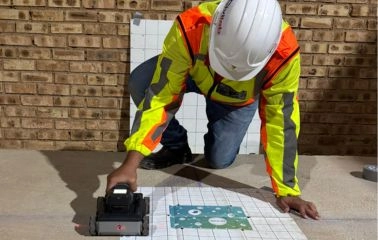
Ground Penetrating Radar GPR 8000 rebar and concrete scanner was used to assess the as-built conditions of the concrete throughout the basement, determine the approximate size, orientation, and depth of steel reinforcement, and support the core extraction process.
Rebound Hammer: Schmidt Rebound hammer testing was performed in conformance with ASTM C805, “Standard Test Method for Rebound Number of Hardened Concrete.” The rebound hammer provided indications of relative concrete strength on the columns in a concrete structure.
The Civilab team can also establish grids to assess the quality of the concrete and detect any honeycombing in the concrete structure.
Pull out test method: Pull-out tests measure the force needed to pull a specially shaped steel rod, cast into concrete, using a special ram. This force correlates with the compressive strength of concrete. The technique quantitatively measures in situ concrete strength and provides insights into maturity and strength development. Although pre-planning is required for formwork insertion, the test offers valuable information on concrete strength in place, with minimal damage if non-destructive.
Ultrasonic pulse velocity method: The ultrasonic pulse velocity test, a dynamic non-destructive test, measures the time taken for an ultrasonic pulse to pass through concrete. It is ideal for establishing concrete uniformity and can be used on existing and under-construction structures. Pulse velocity readings correlate with concrete quality, and the method can detect defects, estimate hardening rate, and predict strength within certain limits.
Frequently Asked Questions
- Which are the non-destructive tests for concrete?
Several methods and tests exist for non-destructive testing of Concrete, including, but not limited to, rebound hammer, ultrasonic pulse velocity, and Ground-Penetrating Radar tests.
- What is the advantage of Non-destructive Testing?
The advantage of Non-destructive Testing is that it provides immediate results on concrete strength and properties without damaging the structure.
- Why Choose Civilab for Concrete Testing?
Whether evaluating new mix designs, testing for compliance, assessing the condition of in-situconcrete, or investigating reasons for failure, Civilab offers a full range of on-site and off-site tests.
Our continued investment in process and technology means we are able to offer a rapid turnaroundfor some of our laboratory tests, without compromising on quality. You can expect to receiveaccurate and reliable results that are delivered promptly to support your project timelines.
To learn more about our non-destructive testing services, contact a member of the Civilab team today. We’ll be more than happy to answer any questions you may have about our services and how we can help you.
- Can non-destructive tests detect internal defects in concrete structures?
Yes, certain NDT methods, such as ultrasonic pulse velocity and ground-penetrating radar, can detect internal defects like voids, cracks, and honeycombing by analyzing wave propagation through the concrete.
- How should results from non-destructive tests be interpreted?
Interpreting NDT results requires understanding the specific method’s principles and limitations. Considering factors like material properties, environmental conditions, and testing procedures is essential. Consulting relevant standards and guidelines is recommended for accurate interpretation.
Civilab’s experienced team will assist you in interpreting the results.
- What is the most common non-destructive test?
The most common non-destructive test is the rebound hammer method.
- What is the limitation of non-destructive concrete testing?
The limitation of Non-destructive Testing of concrete is that the results may be influenced by surface conditions, curing, and variations in the concrete mix.
- Why are non-destructive tests often used as estimators of concrete strength?
NDT methods estimate concrete strength by measuring properties indirectly related to strength, such as surface hardness or wave velocity. These estimates are useful for assessing in-situ concrete without causing damage.
- What are the limitations of non-destructive testing methods?
Limitations can include sensitivity to surface conditions, limited depth penetration, and the need for calibration. Additionally, NDT methods may not provide direct measurements of strength and often require correlation with destructive tests for accurate assessment. In choosing the correct application for NDT, the Civilab team are equipped to assist you in finding the right solution for your application.
- What standards govern non-destructive testing of concrete?
Standards such as ASTM C805 for the rebound hammer test and ASTM C597 for ultrasonic pulse velocity testing provide guidelines on conducting NDT methods. Adherence to these standards ensures consistency and reliability in testing procedures.