
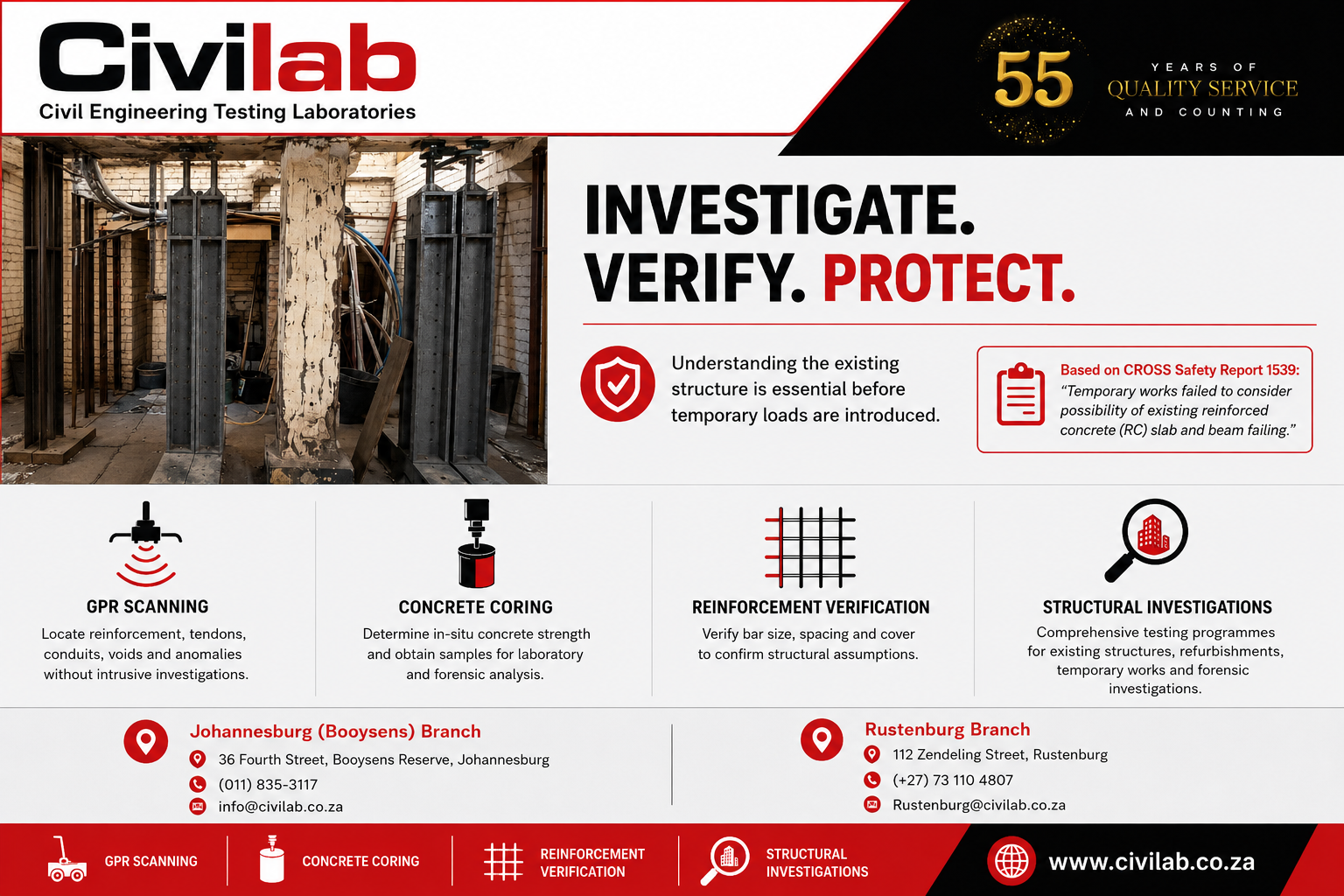
A recent CROSS Safety Report, (Report ID 1539), highlights a critical issue in refurbishment work:
temporary works cannot be designed around the props alone. The existing structure must also be checked.
In the reported case, heavy-duty props were installed to support the removal and replacement of a defective RC column in a multi-storey block of flats. The props themselves could carry the required forces, but the existing beams and slab were later found to lack sufficient bending and shear capacity to transfer the temporary loads safely. CROSS noted that a significant part of the building could have collapsed if the defective column had been removed without additional temporary works.
This is where investigation-led engineering becomes essential.
Civilab assists engineers working on existing buildings by providing factual site and laboratory data to support their structural assessment, including:
- GPR scanning to locate reinforcement, tendons, embedded services, voids, and structural anomalies
- Concrete coring to verify in-situ strength and material condition
- Reinforcement verification and cover surveys
- Testing support for refurbishment, alteration, forensic, and remedial works
Before any work is carried out on site , the engineers need reliable information about the structure that will carry those loads.
Accurate testing helps convert assumptions into evidence.
Reference:
CROSS (2026). Temporary works failed to consider possibility of existing reinforced concrete (RC) slab and beam failing (Report ID 1539). Published 14 May 2026. Available at: https://www.cross-safety.org/uk/safety-information/cross-safety-report/temporary-works-fail-consider-possibility-concrete-failing-1539
#CivilEngineering #StructuralEngineering #TemporaryWorks #ConcreteTesting #GPR #ConcreteCoring #ForensicEngineering #BuildingAssessment #Civilab